If you are noticing thinning hair, you may be comparing two main hair transplant options: FUE (Follicular Unit Extraction) and FUT (Follicular Unit Transplantation).
Both methods move hair from the back or sides of the scalp (donor area) to thinning or balding areas. The main difference is how the hair is extracted and how the donor area heals.
At Hair Transplantation, many individuals attend a consultation seeking clear, easy-to-understand information before choosing a treatment plan. This guide offers a structured comparison of FUE and FUT to help you understand how each method works and how they differ.
What is a FUE hair transplant, and how does it work?
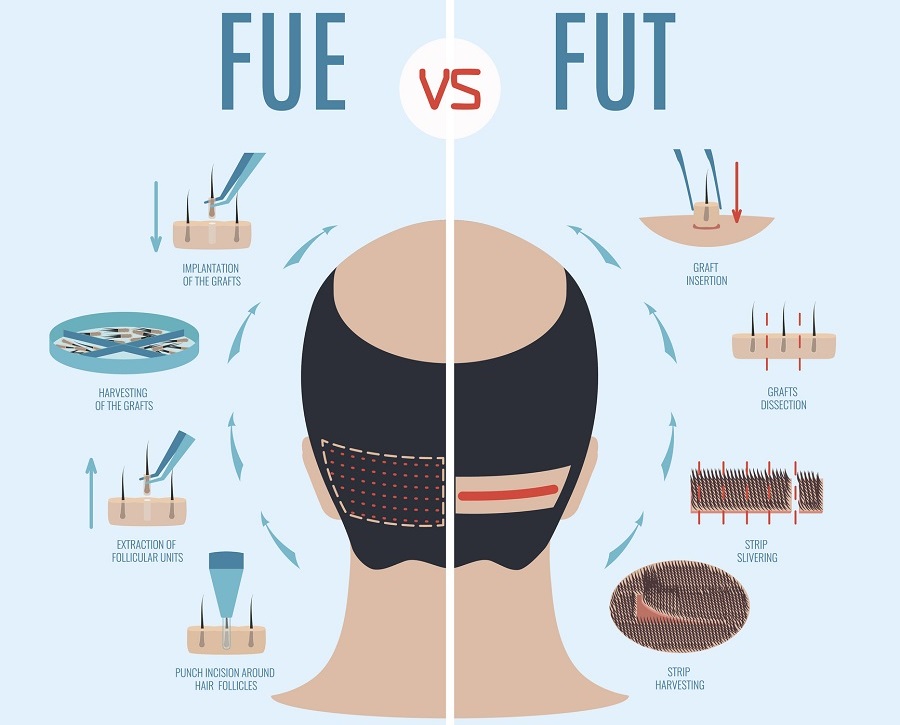
FUE involves extracting individual follicular units directly from the scalp using a small circular punch tool.
Procedure overview
- The donor area is typically trimmed short
- A micro punch (often less than 1 mm in diameter) is used to isolate each follicular unit
- Each graft is removed one by one in a controlled manner
- The extracted grafts are then sorted and prepared for implantation
Technical considerations
- Each follicular unit usually contains 1–4 hairs
- Extraction is generally spread across a wider donor zone to help reduce concentrated stress on any single area
- Healing occurs through very small micro wounds that usually close on their own over time
Clinical characteristics
- It allows targeted harvesting from different regions of the donor area
- It avoids a single linear incision in the scalp
- It may be planned in stages in cases where a larger number of grafts is being considered
FUE hair transplant is commonly chosen for minimal scarring and shorter hairstyles.
What is FUT hair transplant, and how does it work
FUT uses a different harvesting approach compared to FUE. Instead of extracting individual follicular units one by one, a thin strip of scalp may be removed from the donor area.
Procedure overview
- A strip of scalp may be taken from the safe donor zone, usually at the back of the head
- The donor area may be closed with sutures, sometimes using a trichophytic closure technique
- The strip is then dissected under magnification into individual follicular units
- These follicular units are prepared for placement into areas experiencing thinning or hair loss
Technical considerations
- The follicles used are the same as those used in FUE
- The difference lies in how the grafts are harvested, not the grafts themselves
- A linear scar may form in the donor area
- The strip technique may allow a higher number of grafts to be obtained in a single session in some cases
Clinical characteristics
- It may be considered when a larger number of grafts are required in one procedure
- It may allow follicular units to be collected in a concentrated strip, which can be efficiently dissected under magnification
- It may reduce the need for repeated harvesting from multiple areas of the donor zone in certain situations
FUT hair transplant is often used when a higher graft count is required in advanced hair loss.
FUE vs FUT, which is better for hair loss?
Neither FUE nor FUT is universally better. The choice depends on the donor area, hair loss stage, and scalp condition.
Donor management
- FUE spreads the extraction across the donor area
- FUT removes a concentrated strip from one zone
Graft yield and efficiency
- FUT may allow more grafts in one session
- FUE may be limited by safe extraction spacing
Scalp characteristics
- FUT depends on scalp laxity for closure
- FUE depends on donor density and distribution
Both techniques are widely used in modern hair restoration surgery.
Who may be suited to each approach?
Hair transplant planning is usually based on individual assessment rather than preference alone.
FUE may be considered when:
- Hair loss is mild to moderate
- Short hairstyles are preferred
- Minimising visible linear scarring is important
- Donor density is evenly distributed
FUT may be considered when:
- Hair loss is more advanced
- A higher graft count may be required
- The scalp is suitable for strip harvesting
- Maximising graft yield from a limited donor area is important
At Hair Transplantation, these factors are usually assessed during consultation, rather than a single approach being suggested upfront.
Healing and recovery differences
Recovery is not just about time; it also relates to how the scalp heals structurally.
After FUE:
- Small scabs form at the extraction points
- Healing occurs across scattered micro areas
- No single incision line is present
After FUT:
- A linear incision is closed with sutures
- The scar is usually hidden under surrounding hair
- Healing is supported by proper closure techniques
Both methods require proper aftercare to support healing and reduce complications.
In both methods, healing quality depends more on aftercare and individual healing response than on the technique itself.
Are the Hair Outcomes Different?
From a medical point of view, FUE and FUT both use the same type of hair follicles, so the hair that grows is generally similar.
What matters more:
- Graft survival after implantation
- Hair quality from the donor area
- Surgical handling and placement technique
In simple terms, results depend more on graft quality and placement than on the harvesting method.
Conclusion: FUE vs FUT
FUE and FUT are both medically established hair transplant techniques used to treat hair loss.
- FUE focuses on individual extraction with minimal visible scarring
- FUT focuses on strip harvesting with potentially higher graft yield
The most suitable option depends on a clinical assessment of the donor area, hair loss severity, and long-term planning.
A consultation at Hair Transplantation in Melbourne may help determine the most appropriate approach based on individual scalp evaluation.